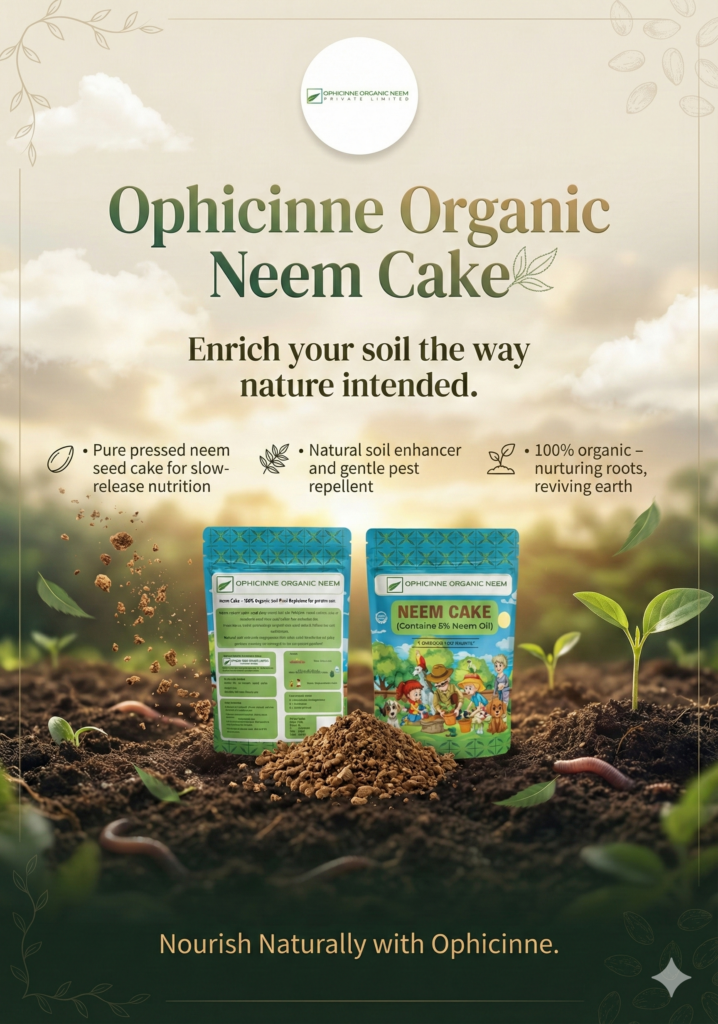
We often focus on what happens above the ground—the leaves, the fruit, the flowers. But the battle for a healthy crop is won or lost in the soil. Modern intensive farming has stripped soils of carbon, leading to compaction and poor water retention. Worse, soil-borne pathogens like nematodes are silently destroying root systems. Enter Neem Cake Fertilizer: the unsung hero of the Ophicinne Organic Products lineup. It is unique among fertilizers because it doesn’t just feed the plant; it heals the earth.
Section 1: What is Neem Cake?
- Explain the byproduct process: After cold-pressing the seeds for oil, the solid residue is the “cake.”
- It is rich in N-P-K (Nitrogen, Phosphorus, Potassium) but also contains residual limonoids from the neem.
- Slow Release: Unlike urea which washes away, Neem Cake releases nitrogen slowly over the crop cycle.
Section 2: The Nematode Solution
- The Problem: Root-knot nematodes cause swellings on roots, stopping nutrient uptake.
- The Mechanism: Neem cake contains nortriterpenoids and isoprenoids. When mixed into the soil, these compounds inhibit the hatching of nematode eggs.
- The Result: Stronger, whiter, deeper root systems.
Section 3: Increasing Efficiency of Other Fertilizers
- Nitrification Inhibition: This is a crucial scientific point. Neem cake slows down the conversion of Nitrogen into Nitrates (which leach away).
- By mixing Neem Cake with other organic manures (like Neem Vermicompost), you make the other fertilizers last longer and work better.
Section 4: How to Apply Ophicinne Neem Cake
- Basal Application: During soil preparation/ploughing.
- Top Dressing: Applying around the root zone for standing crops.
- Dosage: General recommendations for pots vs. acres.
Conclusion: Healthy soil produces healthy food. By integrating Neem Cake Fertilizer into your farm management, you are investing in a soil health enhanc
The Cost of Chemical Farming
- Analyze the hidden costs: destroyed pollinators, health issues for farmers spraying toxins, and the “fertilizer treadmill” (needing more fertilizer every year to get the same yield).
- Discuss the impact on the “Made in India” brand in global markets due to chemical residues.
Neem as the Flagship of Eco-Friendly Farming
- Why Neem? It is indigenous to India, requires little water to grow, and every part of the tree is useful.
- Carbon Sequestration: Discuss how promoting neem cultivation (which Ophicinne does in Banswara) helps fight climate change.
- Zero-Waste Production: How Ophicinne utilizes the oil for pests and the cake for soil, ensuring a circular economy.
The Consumer Demand Shift
- Consumers are reading labels. They want “Residue-Free” food.
- Using Ophicinne Natural Neem allows farmers to brand their produce as “naturally grown” or “organic,” fetching a higher market price.
The Ophicinne Ecosystem (150 words)
- Highlighting the social sustainability: Employing tribal women, fair trade sourcing, and community development in Rajasthan.
Conclusion: Eco friendly farming isn’t just about saving the planet; it’s about saving the farmer. Join Ophicinne in the movement to GrowNaturally.