
Blog

Supercharge Your Soil: How to Use Neem Vermicompost for Bigger Yields

There is an old saying: “The earthworm is the farmer’s best friend.” For millions of years, these tiny creatures have been ploughing the earth, eating organic waste, and turning it into nutrient-rich “black gold” (castings).

But at Ophicinne, we asked a question: Can we make the best fertilizer even better?

The answer is Neem Vermicompost.

By combining the biological magic of earthworms with the pest-fighting power of the Neem tree, we have created a super-fertilizer. It doesn’t just feed your plants; it protects them. In this article, we explore why this hybrid manure is the secret weapon for anyone looking to improve crop yield naturally.

What is Neem Vermicompost?

Standard vermicompost is made by earthworms decomposing organic matter (cow dung, leaves, etc.). Ophicinne Neem Vermicompost takes this process a step further. We introduce Neem Cake into the composting process. The earthworms digest this mixture, and the resulting castings are enriched with the properties of neem.

It is a 2-in-1 product:

  1. Bio-Fertilizer: Rich in Nitrogen, Phosphorus, Potassium, and essential micronutrients like Calcium and Magnesium.
  2. Bio-Pesticide: Contains traces of neem limonoids that repel soil-borne pests.

Why Is It Better Than Regular Cow Manure?

Raw cow dung is great, but it has problems. It can carry weed seeds, it can burn tender roots if it’s too fresh (“hot”), and it often contains harmful pathogens. Vermicomposting eliminates these issues. The worms break down the pathogens and weed seeds. The final product is:

  • Cool & Stable: You can apply it directly to roots without fear of burning.
  • Loaded with Microbes: It contains millions of beneficial bacteria that help the plant absorb nutrients.
  • Water Retentive: It acts like a sponge, holding moisture in the soil so you have to water less often.

The “Neem” Advantage

The real game-changer is the neem content. Soil pests like White Grubs and Termites often attack plant roots. If you use regular manure, you might actually be feeding these pests. But when you use Neem Vermicompost, the bitter compounds from the neem discourage these pests from coming near the root zone. It creates a “safe zone” for your roots to grow deep and strong.

How to Use It for Maximum Results

1. For Potting Mix (Home Gardeners)

Don’t use garden soil alone; it compacts too easily.

  • Recipe: Mix 30% Ophicinne Neem Vermicompost + 30% Coco Peat + 40% Garden Soil.
  • This creates a light, airy, nutrient-dense mix that your indoor plants and vegetables will love.

2. For Vegetable Beds

  • Top Dressing: Every month, add a handful of vermicompost to the base of your tomato, chili, or brinjal plants. Gently mix it into the top inch of soil and water it in. This gives them a “nutrient boost” exactly when they are flowering.

3. For Fruit Trees

  • Dig a ring around the drip line of the tree. Fill it with 1-2 kg of Neem Vermicompost and cover it back up. This feeds the feeder roots directly.

Conclusion: The Foundation of Organic Success

You cannot grow a healthy house without a strong foundation. In farming, your soil is that foundation. Neem Vermicompost is the easiest, most effective way to restore life to dead soil. It brings back the carbon, the microbes, and the nutrients, while keeping the bad bugs at bay.

What is Cold Pressed Neem Oil and Why Is It Better Than Regular Neem Oil?

Walk into any garden center or scroll through Amazon, and you will see dozens of bottles labeled “Neem Oil.” Some are clear, some are dark brown. Some smell like citrus, others have a pungent garlic odor. Some are cheap, while others command a premium price.

As a consumer, it is confusing. Is there really a difference?

The short answer is yes. The difference between a generic neem oil and Ophicinne’s Cold Pressed Neem Oil isn’t just about color or smell—it is the difference between a product that works and one that doesn’t.

In the world of organic farming solutions, the extraction method is everything. Today, we are pulling back the curtain on the manufacturing process to explain why “Cold Pressed” matters and why heat is the enemy of quality.https://ophicinne.com/

The Chemistry of the Miracle Tree

To understand the oil, you must understand the seed. The Neem tree (Azadirachta indica) produces fruit containing seeds rich in oil. But the magic isn’t just in the oil itself; it’s in the compounds suspended within that oil.

The most important compound is Azadirachtin.

Azadirachtin is a complex tetranortriterpenoid. In simple terms, it is the molecule that messes up the digestive and hormonal systems of pests. The higher the concentration of Azadirachtin (measured in PPM or Parts Per Million), the more powerful the oil is as a pesticide.

However, Azadirachtin is a “diva.” It is incredibly sensitive. It breaks down rapidly when exposed to:

  1. High Temperatures.
  2. Harsh Solvents (like Hexane).
  3. UV Light.

This is where the manufacturing process decides the fate of the product.

The Three Methods of Extraction

1. Solvent Extraction (The “Fake” Stuff)

Many large industrial manufacturers use chemicals like hexane to pull oil from the seeds. This method is fast and cheap, extracting almost every drop of oil. However, the chemical solvents strip away the beneficial compounds, and the subsequent heating process to remove the solvent destroys whatever Azadirachtin was left. The result is a clarified, hydrophobic oil that is shiny but chemically “dead.”

2. Heat Expeller Pressing

This is a mechanical method, but it uses high friction which generates temperatures above 140°F (60°C). While better than chemicals, this heat still degrades a significant portion of the active ingredients.

3. Cold Pressing (The Ophicinne Way)

Cold Pressed Neem Oil is the “Extra Virgin Olive Oil” of the agriculture world. At Ophicinne, we use advanced mechanical presses that crush the seeds slowly. This slow process ensures that the temperature never rises above 120°F (approx 49°C).

By keeping the temperature low, we preserve the Azadirachtin, along with other vital limonoids like Nimbin and Salannin.

The Brazilian Technology Advantage

While our seeds come from the rugged, nutrient-rich soils of the Banswara tribal belt in India, our processing technology is global.

We have partnered with Ophicina Orgânica from Brazil to utilize state-of-the-art cold pressing machinery. Why Brazil? Because Brazil is a world leader in bio-agriculture technology. Their engineering ensures that our extraction is not only cold but also incredibly precise, filtering out impurities without removing the active compounds.

This fusion of Indian raw material and Brazilian engineering gives us a pure neem oil for plants that is stable, potent, and clean.

How to Spot “Real” Cold Pressed Oil

If you have a bottle of neem oil at home, how can you tell if it is the good stuff? Here are three simple tests you can do right now.

The Smell Test

Open the bottle.

  • Real Cold Pressed Oil: It should hit you with a strong, pungent odor. It is often described as a mix of garlic, sulfur, and peanut butter. It is not pleasant, but it is the smell of potency.
  • Fake/Refined Oil: If it smells virtually odorless, or if it smells like lemon (added fragrance), it has likely been refined or diluted.

The Color Test

  • Real Cold Pressed Oil: It should be a dark, murky, golden-brown or greenish-brown color. It is thick and viscous.
  • Fake/Refined Oil: It often looks like clear vegetable oil or has a light yellow tint.

The Fridge Test (The Ultimate Proof)

Neem oil has a high melting point (around 13°C or 55°F).

  • Put your bottle in the fridge for 20 minutes.
  • Real Cold Pressed Oil: It will start to solidify and turn into a buttery paste. You might need to warm it up in warm water to use it again.
  • Fake/Refined Oil: If it stays completely liquid in the fridge, it has likely been cut with cheaper carrier oils or solvents.

Why Cold Pressed is More Cost-Effective

You might notice that Cold Pressed Neem Oil costs slightly more than the generic stuff. But when you do the math, it is actually cheaper.

Because the Azadirachtin content is so high (often 1500-3000 PPM or more), you need to use less of it to get results.

  • Generic Oil: You might need 10-15ml per liter to see any effect on pests.
  • Ophicinne Oil: You often only need 3-5ml per liter.

One bottle of Ophicinne goes three times as far as a bottle of cheap extract. Plus, you save money by not losing your crops to pests!

Conclusion: Respect the Seed

At Ophicinne Organic Neem, we believe that if nature took the time to create a seed as perfect as the Neem seed, we shouldn’t ruin it in a factory.

By choosing Cold Pressed Neem Oil, you are choosing a product that is raw, honest, and scientifically superior. Whether you are fighting aphids on your roses or managing pests on 100 acres of cotton, the quality of your oil determines the quality of your harvest.

Don’t compromise. Choose the oil that still has the soul of the seed inside it.

The Dual-Action Miracle: How Neem Cake Fertilizer Acts as Both Food and Medicine for Your Soil

We often focus on what happens above the ground—the leaves, the fruit, the flowers. But the battle for a healthy crop is won or lost in the soil. Modern intensive farming has stripped soils of carbon, leading to compaction and poor water retention. Worse, soil-borne pathogens like nematodes are silently destroying root systems. Enter Neem Cake Fertilizer: the unsung hero of the Ophicinne Organic Products lineup. It is unique among fertilizers because it doesn’t just feed the plant; it heals the earth.

Section 1: What is Neem Cake?

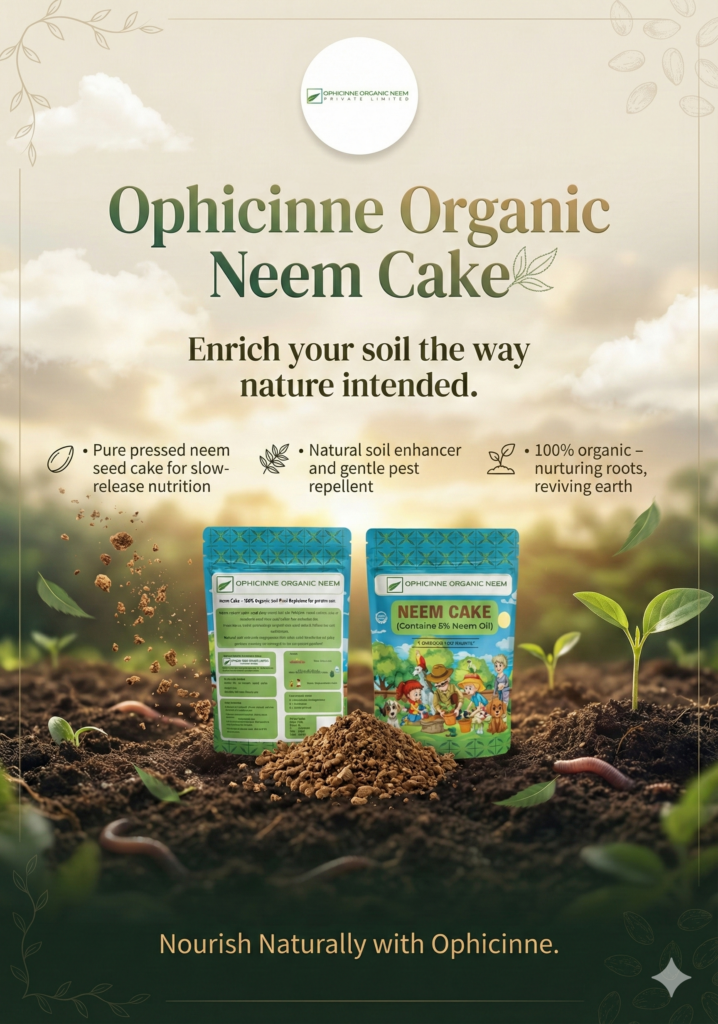
  • Explain the byproduct process: After cold-pressing the seeds for oil, the solid residue is the “cake.”
  • It is rich in N-P-K (Nitrogen, Phosphorus, Potassium) but also contains residual limonoids from the neem.
  • Slow Release: Unlike urea which washes away, Neem Cake releases nitrogen slowly over the crop cycle.

Section 2: The Nematode Solution

  • The Problem: Root-knot nematodes cause swellings on roots, stopping nutrient uptake.
  • The Mechanism: Neem cake contains nortriterpenoids and isoprenoids. When mixed into the soil, these compounds inhibit the hatching of nematode eggs.
  • The Result: Stronger, whiter, deeper root systems.

Section 3: Increasing Efficiency of Other Fertilizers

  • Nitrification Inhibition: This is a crucial scientific point. Neem cake slows down the conversion of Nitrogen into Nitrates (which leach away).
  • By mixing Neem Cake with other organic manures (like Neem Vermicompost), you make the other fertilizers last longer and work better.

Section 4: How to Apply Ophicinne Neem Cake

  • Basal Application: During soil preparation/ploughing.
  • Top Dressing: Applying around the root zone for standing crops.
  • Dosage: General recommendations for pots vs. acres.

Conclusion: Healthy soil produces healthy food. By integrating Neem Cake Fertilizer into your farm management, you are investing in a soil health enhanc

The Cost of Chemical Farming

  • Analyze the hidden costs: destroyed pollinators, health issues for farmers spraying toxins, and the “fertilizer treadmill” (needing more fertilizer every year to get the same yield).
  • Discuss the impact on the “Made in India” brand in global markets due to chemical residues.

Neem as the Flagship of Eco-Friendly Farming

  • Why Neem? It is indigenous to India, requires little water to grow, and every part of the tree is useful.
  • Carbon Sequestration: Discuss how promoting neem cultivation (which Ophicinne does in Banswara) helps fight climate change.
  • Zero-Waste Production: How Ophicinne utilizes the oil for pests and the cake for soil, ensuring a circular economy.

The Consumer Demand Shift

  • Consumers are reading labels. They want “Residue-Free” food.
  • Using Ophicinne Natural Neem allows farmers to brand their produce as “naturally grown” or “organic,” fetching a higher market price.

The Ophicinne Ecosystem (150 words)

  • Highlighting the social sustainability: Employing tribal women, fair trade sourcing, and community development in Rajasthan.

Conclusion: Eco friendly farming isn’t just about saving the planet; it’s about saving the farmer. Join Ophicinne in the movement to GrowNaturally.

The Ultimate Guide to Using Pure Neem Oil for Plants: Dosage, Benefits, and Common Mistakes

Every gardener, from the balcony enthusiast to the large-scale organic farmer, eventually faces the same enemy: pests. Aphids, mealybugs, and spider mites can decimate a crop in days. The conventional answer has always been chemical sprays, but the tide is turning. As we learn more about the dangers of synthetic residues, the demand for pure neem oil for plants has skyrocketed. But neem oil isn’t just a simple spray; it’s a complex, powerful botanical tool. In this guide, brought to you by Ophicinne Organic Neem, we will break down exactly how to use this ancient remedy to protect your green space effectively and safely.

Section 1: What is Cold Pressed Neem Oil?

  • Explain the difference between hydrophobic neem oil (often found in big box stores, stripped of Azadirachtin) and Cold Pressed Neem Oil (what Ophicinne sells).
  • Key Insight: Explain that Azadirachtin is the active ingredient that affects the insect’s hormonal system. Heat destroys it. Only cold-pressing preserves it.
  • Why Ophicinne? Mention the Banswara sourcing and Brazilian technology that ensures high stability of these volatile compounds.

Section 2: The Science: How It Works on Pests

  • Antifeedant Properties: It doesn’t kill on contact; it stops the bug from eating. The bug starves.
  • Growth Regulator: It stops the larvae from molting into adults.
  • Oviposition Deterrent: It stops moths/flies from laying eggs on the leaves.
  • List of targeted pests: Aphids, Whiteflies, Mealybugs, Thrips, Caterpillars, Spider Mites.

Section 3: Step-by-Step: How to Mix and Apply

  • The Emulsifier Rule: Explain that oil and water don’t mix. You must use a surfactant (like mild soap or a specialized emulsifier).
  • The Golden Ratio: Provide a clear recipe.
    • Maintenance Dose: 3-5ml Ophicinne Neem Oil + 1L Water + A pinch of soap.
    • Infestation Dose: 5-10ml Ophicinne Neem Oil + 1L Water + Soap.
  • Timing: “Do not spray in the sun.” Explain phytotoxicity (leaf burn). Spray in the early morning or late evening.
  • Frequency: Every 7-10 days for prevention; every 3 days for active infestation.

Section 4: Common Mistakes Beginners Make

  • Using old oil (Azadirachtin breaks down).
  • Not shaking the mixture enough.
  • Expecting instant “knockdown” (dead bugs immediately). Explain patience is key with organics.

 Switching to natural pest control requires a shift in mindset. It’s about long-term ecosystem health, not short-term destruction. With Ophicinne Neem Oil, you are equipping your garden with the best nature has to offer.

Not All Neem Oil is Created Equal: The Benefit of Cold Pressed Neem Oil

Walk into any agriculture shop, and you will see dozens of bottles labeled “Neem Oil.” But did you know that most of them have lost their effectiveness before you even open the cap?

At Ophicinne Organic Neem, we understand that potency is everything. That is why we specialize in Cold Pressed Neem Oil.

Why “Cold Pressed” Matters The key ingredient in neem that repels pests is called Azadirachtin. This compound is very sensitive to heat. Many manufacturers use heat or chemicals to extract oil faster, which destroys the Azadirachtin. Our pure neem oil for plants is extracted without heat, ensuring that every drop is packed with the active compounds needed for effective plant protection solutions.

The Ophicinne Difference We don’t just stop at extraction. By using advanced processing technology, we ensure our oil remains stable on the shelf. Whether you are using it for a small home garden or large-scale Neem farming, you are getting a natural neem oil that performs consistently.

Improves Crop Yield Naturally When you use a high-quality oil, you don’t just stop pests; you improve the overall health of the plant. Healthy plants produce more fruit. It is the simplest way to improve crop yield naturally without risking chemical residue on your harvest.

Don’t compromise on quality. Shop the Ophicinne Neem Oil collection now.

Why Chemical Free Crop Protection is the Future of Farming 

For decades, the answer to a pest problem was simple: spray more chemicals. But today, farmers across India are realizing that this “quick fix” is actually a long-term disaster. Chemical fertilizers and pesticides strip the soil of its natural nutrients, leading to hard, lifeless land that requires even more chemicals to grow anything.

This is where Ophicinne Organic Neem steps in. We believe in eco friendly farming that works with nature, not against it.

The Power of Natural Pest Control Unlike synthetic poisons, Neem oil for pest control works differently. It disrupts the life cycle of pests rather than just killing them instantly. This means pests don’t develop resistance to it. Using a bio pesticide neem oil ensures that you are protecting your crops without poisoning the groundwater or killing beneficial insects like bees.

More Than Just Protection: A Soil Health Enhancer Switching to organic inputs like Neem Cake Fertilizer does double duty. It protects plant roots from nematodes and white ants while simultaneously acting as a soil health enhancer. It adds organic carbon back into the earth, improving water retention and aeration.

 If you want to ensure your land remains fertile for the next generation, it’s time to switch to organic farming solutions Ready to heal your soil? Explore our range of Ophicinne Organic Products today.

sfsfsfsfsfsfsfsf

sfsfsfsfs

sfsfsfsfsfsfsfsf

sfsfsfsfsfsfsf


ssfs

zczczcz

zczczczczczcc

zczczczczc

Info Box

Click here to change this text. Lorem ipsum dolor sit amet, consectetur adipiscing elit. Ut elit tellus, luctus nec ullamcorper mattis, pulvinar dapibus leo.

The Role of Neem in Organic Farming: A Natural Way to Healthy Crops

The Role of Neem in Organic Farming: A Natural Way to Healthy Crops

Introduction

Neem has been an integral part of Indian agriculture for centuries. Known for its natural pest-control and soil-improving properties, neem plays a vital role in organic and sustainable farming. With rising concerns about soil degradation and chemical residue, farmers are now turning back to neem-based solutions for healthier crops and long-term soil fertility.


🌿 Neem – A Natural Protector for Crops

Neem contains natural compounds that help protect crops from harmful insects and soil-borne pests. Unlike chemical pesticides, neem works gently by disturbing the feeding and growth cycle of pests without harming beneficial insects.

This makes neem an ideal choice for farmers who want to protect their crops while maintaining ecological balance.


🌱 Improves Soil Health Naturally

Neem-based inputs help improve soil structure and microbial activity. When used in organic farming, neem supports better nutrient absorption and reduces nutrient loss from the soil. Over time, this results in healthier roots, stronger plants, and improved crop yield.


🌾 Supports Sustainable & Organic Farming

Organic farming focuses on long-term soil health rather than short-term gains. Neem perfectly aligns with this approach as it:

  • Reduces dependence on chemical fertilizers

  • Improves soil fertility naturally

  • Supports eco-friendly agricultural practices

Farmers using neem regularly experience better crop quality and sustainable productivity.


🌍 Conclusion

Neem is not just a traditional remedy but a scientifically proven solution for modern organic farming. By adopting neem-based agricultural practices, farmers can protect their crops, improve soil health, and contribute to a greener and healthier future.

Neem truly represents nature’s solution for sustainable agriculture.